
Cavapoo Growth Chart: Weight and Size by Age

Quick answer: A Cavapoo growth chart shows most puppies reaching about half their adult weight by 4 months, most of their height by 10 to 12 months and their full weight by 12 to 18 months. Adults typically weigh 8 to 25 pounds depending mainly on the Poodle parent, and published charts disagree, so treat any Cavapoo growth chart as a range. The best size predictor is the parents’ adult weights, so ask your breeder.
Every new owner wants a Cavapoo growth chart, but most online charts disagree and few explain why. This guide gives a practical Cavapoo growth chart with typical weight and size by age, shows where published charts conflict, and explains how to estimate your own puppy’s adult size. It also covers when Cavapoos stop growing, how neutering and sex affect growth, why ‘teacup’ Cavapoos are risky, and how to track your puppy’s weight. We rely on PetMD, a large veterinary growth study of more than 6 million dogs, PDSA and breeder and publisher charts, and we say clearly where evidence is weak.
Disclosure: some links in this guide are Amazon affiliate links. If you buy through them we may earn a small commission at no extra cost to you.
Cavapoo Growth Chart: How Big Do Cavapoos Get?
Adult Cavapoos typically weigh about 8 to 25 pounds and stand 9 to 14 inches tall, according to PetMD, with size depending mainly on whether the Poodle parent was a Toy or a Miniature. There is no official breed standard, so any Cavapoo growth chart is a range, not a promise. Most puppies reach about half their adult weight by 4 months, most of their height by 10 to 12 months and their full weight by 12 to 18 months.
A Cavapoo is a cross between a Cavalier King Charles Spaniel and a Poodle, so puppies from the same litter can end up different sizes. For choosing between sizes, see our toy vs mini Cavapoo guide, and for the whole profile read the Cavapoo breed guide.

Cavapoo Growth Chart by Age: What Published Charts Say
Here is the problem with most online charts: they disagree. We compared two widely used charts that list weight by age, and the gaps are large, especially from 6 months onward. This is not a mistake so much as a sign of how variable the cross is, because a Cavapoo can have a Toy Poodle or a Miniature Poodle parent and no standard keeps the sizes consistent.
| Age | Chart A (Dogster, vet-reviewed) | Chart B (Hepper) |
|---|---|---|
| 1 month | 2 to 5 lb | 3 to 4 lb |
| 3 months | 5 to 10 lb | 5 to 7 lb |
| 6 months | 8 to 16 lb | 8 to 10 lb |
| 10 months | 10 to 20 lb | 10 to 14 lb |
| 12 months | 10 to 22 lb | 10 to 17 lb |
| 14 months | 10 to 25 lb | 10 to 23 lb |
The wide ranges mean a healthy puppy can sit anywhere inside them. Use a Cavapoo growth chart to spot a puppy that is far outside the range, not to judge whether a puppy is ‘on track’ to the pound. A puppy that is steadily gaining weight and has a good body condition is usually fine, so ask your vet if you are unsure. See our feeding guide for calorie-based portions while your puppy grows.
Cavapoo Growth Chart by Size: Toy vs Miniature
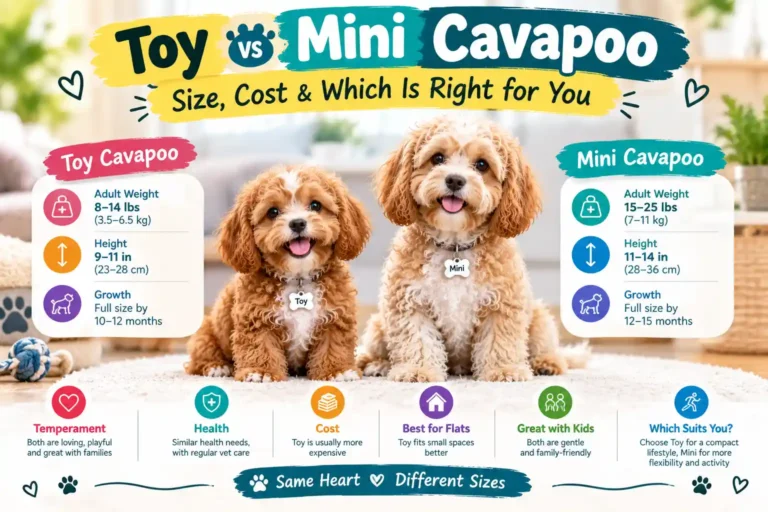
The Poodle parent drives adult size, so any honest Cavapoo growth chart should say whether it assumes a Toy or Miniature parent. Breeder and publisher guides usually divide Cavapoos into Toy and Miniature types, although the figures differ a little between sources.
| Type | Typical adult weight | Typical adult height | Notes |
|---|---|---|---|
| Toy-type Cavapoo | About 7 to 13 lb | About 9 to 12 in | Toy Poodle parent; most common smaller size |
| Miniature-type Cavapoo | About 12 to 25 lb (some guides say 13 to 20 lb) | About 12 to 16 in | Miniature Poodle parent |
| Larger crosses | About 20 to 30 lb or more | About 15 to 18 in | Uses a larger Poodle; less common |
| Teacup (not an official size) | Under about 7 lb | Under about 9 in | Marketing term; extra risks, see below |
Our Cavapoo vs Cavalier vs Poodle guide explains how the parents’ sizes shape your puppy, and PetMD’s overall range of 8 to 25 pounds covers most of these types. Because F1b puppies (bred back to a Poodle) can differ in size, see our F1b Cavapoo guide too.

Cavapoo Growth Timeline: What to Expect Month by Month
| Age | Growth milestone (rule-of-thumb) | What to focus on |
|---|---|---|
| 8 weeks | Roughly 2 to 6 lb, depending on the parents | Safe settling in; see our first week guide |
| 4 months | About half of adult weight | Teething begins; steady gain; see puppy biting |
| 6 months | Roughly 50 to 75% of adult weight; much of the height is set | Switch to fewer meals; keep exercise gentle |
| 10 to 12 months | Height is usually set; weight is close to adult | Move to adult food when your vet agrees |
| 12 to 18 months | Weight and body shape finish filling out | Check body condition; adult routine |
This Cavapoo growth chart timeline comes from published guides and is a set of rules of thumb, not veterinary standards. A large study of weight data from over 6 million dogs notes that very small dogs reach maturity at about 8 to 12 months, while larger breeds can take up to 24 months, so a Toy-type Cavapoo may finish earlier than a larger one. For daily care at each stage, see our puppy first week guide, puppy biting guide and Cavapoo exercise guide.
How to Predict Your Cavapoo’s Adult Size
No method or Cavapoo growth chart is exact, but these help, in order of reliability:
- The parents’ adult weights. Ask your breeder for the mother’s and father’s actual weights and the Poodle size. This is the strongest clue, as My Doodle Puppy also advises when you want a small dog.
- Your puppy’s 4-month weight. Many guides say a Cavapoo weighs about half its adult weight at 4 months, so doubling the 16-week weight gives a rough estimate.
- Your vet’s growth chart. Vets can plot your puppy against evidence-based size-category curves.
| Puppy weight at 16 weeks | Rough adult weight estimate (x1.8 to x2.2) |
|---|---|
| 5 lb | 9 to 11 lb |
| 6 lb | 11 to 13 lb |
| 7 lb | 13 to 15 lb |
| 8 lb | 14 to 18 lb |
| 9 lb | 16 to 20 lb |
| 10 lb | 18 to 22 lb |
This table is our own arithmetic: we take the common ‘double the 4-month weight’ rule and add roughly 10% either way to show the uncertainty. It is a rough guide, and individual puppies vary. Paw size and coat are weak predictors, so do not rely on them.
How to Track Your Cavapoo Growth Chart at Home
Weigh your puppy every one to two weeks on the same scale, and write the numbers down as your own Cavapoo growth chart. Compare the trend, not a single weigh-in. Steady gains are the goal. Researchers who built vet growth standards note that overly rapid growth or catch-up growth is a known risk factor for becoming overweight, so overfeeding to hit a bigger number is not helpful. The study, by Salt and colleagues at the WALTHAM Centre and Banfield Pet Hospital, used records from over 6 million dogs and found that growth can be described using size categories rather than breed.
A small digital kitchen scale, such as the Etekcity digital kitchen scale (11 lb / 5 kg capacity, 1 g steps), works for a young puppy. The platform is small, so put a shallow box or a towel-lined tray on it, press the tare button to zero it, then lift your puppy in and read the weight. Once your puppy gets close to 11 lb, switch to the bathroom scale method: weigh yourself holding your puppy, then weigh yourself alone and subtract. Use the same method each time so the numbers are comparable.
- Weigh every one to two weeks on the same scale
- Feel the ribs: easy to feel but not sharply visible
- Look for a waist from above
- Ask your vet to plot your puppy on a growth standard at vaccination visits
- Call your vet if weight stalls, drops, or climbs very fast
Using the study’s size categories, most Cavapoos would fall in the first three: under 6.5 kg, 6.5 to under 9 kg, or 9 to under 15 kg, which is about 14 lb, 20 lb and 33 lb. The authors note the charts still need further validation before they become a clinical tool.
Do Neutering and Sex Change a Cavapoo Growth Chart?
A little, but neutering barely moves a Cavapoo growth chart curve compared with individual variation. In the large veterinary study, neutering before about 37 weeks was associated with a slight upward shift in growth, and neutering after 37 weeks with a slight downward shift, yet these shifts were small compared with differences between individual dogs. The study also found males grow at a different, slightly faster rate than females. Discuss the timing of neutering with your vet, and watch weight afterwards because neutering is a risk factor for weight gain. See our feeding guide for adjusting portions.
Toy and Teacup Cavapoos: What to Know
‘Teacup’ is not an official size, and no honest Cavapoo growth chart includes it; a very small Cavapoo is not a premium dog. My Doodle Puppy notes that very small puppies are more prone to low blood sugar, are hurt more easily by falls and feel the cold more. If you want a small Cavapoo, ask the breeder for the parents’ actual weights and avoid anyone selling a tiny puppy as rare or special. Our breeder guide and health tests guide help you spot red flags.
When Is a Cavapoo Fully Grown?
Most Cavapoos reach their full height by about 10 to 12 months, and their weight can keep filling out until about 12 to 18 months. PDSA says most dogs are fully grown by about one year, and that until then growth plates and joints are at risk if they do too much intense exercise. Treat your Cavapoo as still growing for the first year, and remember that a Cavapoo growth chart ends where your own dog’s curve levels off.
That means avoiding jogging and long hikes until your vet confirms growth is complete, as our exercise guide explains. Our lifespan guide covers what happens next.
Cavapoo Growth Chart: The Bottom Line
A realistic Cavapoo growth chart is a range: about half of adult weight at 4 months, height set by 10 to 12 months and full weight by 12 to 18 months, with adults typically 8 to 25 pounds. Published charts disagree, so rely on the parents’ adult weights, weigh your puppy regularly, aim for steady gains and a good body condition, and ask your vet to plot growth on a proper standard.
Choosing between sizes?
Compare Toy and Miniature Cavapoos on size, cost and health before you pick a puppy.
Read Toy vs Mini CavapooFrequently Asked Questions About the Cavapoo Growth Chart
How big do Cavapoos get?
Adult Cavapoos typically weigh about 8 to 25 pounds and stand 9 to 14 inches tall, according to PetMD. The Poodle parent’s size is the main factor, and a Cavapoo growth chart should be treated as a range.
How much should a 3-month-old Cavapoo weigh?
Published charts give about 5 to 7 pounds in one source and 5 to 10 pounds in another, depending on the parents. A healthy puppy steadily gaining weight with a good body condition is usually fine.
How much should a 6-month-old Cavapoo weigh?
Charts disagree, with one listing 8 to 16 pounds and another 8 to 10 pounds. Roughly 50 to 75% of adult weight is a common rule of thumb at this age.
When do Cavapoos stop growing?
Most reach full height by about 10 to 12 months and full weight by about 12 to 18 months. Smaller dogs may finish earlier, with very small dogs maturing at 8 to 12 months.
How can I tell how big my Cavapoo will get?
Ask the breeder for the parents’ adult weights and the Poodle size. A rough check is to double the weight at 4 months, but that is only an estimate.
Is a Toy Cavapoo smaller than a Miniature Cavapoo?
Yes. A Toy-type Cavapoo is typically about 7 to 13 pounds, while a Miniature-type is about 12 to 25 pounds, depending on the Poodle parent.
What is a teacup Cavapoo?
It is a marketing term for a very small Cavapoo, usually under about 7 pounds. It is not an official size, and very small puppies are more prone to low blood sugar and injuries.
Does neutering stunt a Cavapoo’s growth?
No strong evidence suggests that. A large veterinary study found neutering shifted growth trajectories only slightly compared with differences between individual dogs.
Do male Cavapoos grow bigger than females?
Males grow at a slightly faster rate than females in a large veterinary study, and males can end up a little heavier, but size depends far more on the parents.
How often should I weigh my Cavapoo puppy?
Every one to two weeks, on the same scale, and record the numbers. Ask your vet to compare them with a growth standard at check-ups.
Affiliate disclosure: as an Amazon Associate we earn from qualifying purchases at no extra cost to you. We only link products we would recommend to a friend with a Cavapoo.
Sources and Further Reading
- PetMD, Cavapoo Dog Breed Health and Care, petmd.com (adult weight 8 to 25 lb and height 9 to 14 in)
- Dogster, How Big Does a Cavapoo Get?, dogster.com (weight and height by age (Chart A))
- Hepper, How Big Does a Cavapoo Get?, articles.hepper.com (weight and height by age and Toy/Miniature sizes (Chart B))
- My Doodle Puppy, Cavapoo Full Grown Sizes, mydoodlepuppy.com (size types, 4-month and 6-month rules of thumb, teacup risks)
- Honest Pet, How Big Do Cavapoo Puppies Get?, honestpet.com (8-week weights and 6-month percentage of adult weight)
- Furrylicious, Cavapoo Size Chart, furrylicious.com (double the 4-month weight rule)
- Salt et al. (2017), Growth standard charts for monitoring bodyweight in dogs of different sizes, PLoS ONE, pmc.ncbi.nlm.nih.gov (evidence-based growth standards from over 6 million dogs; neutering and sex effects)
- ScienceDaily, Growth charts for dogs (University of Liverpool and WALTHAM), sciencedaily.com (males grow faster than females; neutering effects small)
- PDSA puppy exercise guidance (as reported by Burgess Pet Care), burgesspetcare.com (most dogs fully grown by about one year)
This guide is general information and not a substitute for advice from your vet or a qualified trainer. Cost figures are planning estimates and vary by region.

Written by Rachel DoyleFounder of The Cavapoo Guide and owner of Winnie and Ziggy. About Rachel →
This article is part of our Complete Cavapoo Breed Guide →




One Comment