
Health Tests to Ask a Cavapoo Breeder: Full Checklist
Quick answer: The health tests to ask a Cavapoo breeder for are a heart exam, an eye exam and a kneecap check on both parents, DNA tests for inherited Cavalier and Poodle conditions (such as curly coat/dry eye, episodic falling and prcd-PRA), and, ideally, MRI screening for syringomyelia. Ask for the original certificates, check they name the dog or microchip, and walk away if the breeder only says puppies are “vet checked”.
A cute puppy and a fair price tell you nothing about the parents’ health. This guide lists the health tests to ask a Cavapoo breeder for, test by test, with what each one screens for, how often it should be repeated, how to read the results and how to verify the paperwork, so you can judge a breeder before you fall in love with a litter.
Why Health Tests to Ask a Cavapoo Breeder Matter
A Cavapoo inherits from two breeds. The Cavalier King Charles Spaniel parent is prone to mitral valve disease and syringomyelia, and the Poodle side can add eye and kneecap problems. Crossing the two does not cancel the risks.
Vets and breed clubs warn that crossbreeds can double up on health issues rather than escape them, so the “hybrid vigour” claim is overstated.
Health testing is the only practical way to lower the odds. It cannot guarantee a healthy puppy, but it separates careful breeders from sellers who skip it. For the wider buying checklist, see our Cavapoo breeder guide.
The Cavapoo Health Tests Checklist at a Glance
| Test | Parent | How often | What it screens for |
|---|---|---|---|
| Cardiac exam (specialist) | Both | Yearly | Heart murmurs and mitral valve disease |
| Eye exam (ophthalmologist) | Both | Yearly | Hereditary cataracts, retinal disease |
| Kneecap (patella) check | Both | Yearly or before breeding | Luxating patella |
| MRI for syringomyelia | Cavalier side | Once, after maturity | Fluid cavities in the spinal cord (optional but valuable) |
| DNA: curly coat/dry eye (CC/DE) | Cavalier side | Lifetime | Inherited eye and skin condition |
| DNA: episodic falling (EF) | Cavalier side | Lifetime | Inherited collapse episodes |
| DNA: prcd-PRA | Poodle side | Lifetime | Progressive retinal atrophy |
| DNA: von Willebrand type I | Poodle side | Lifetime | Inherited bleeding disorder |
Accredited-breeder schemes for Cavaliers list yearly eye, cardiac and kneecap certificates and DNA tests for CC/DE and EF as mandatory, with MRI for syringomyelia as optional. Test lists differ by country and breed club, so confirm the current one with your vet.
Heart Tests: The First Health Test to Ask a Cavapoo Breeder For
Mitral valve disease is the biggest health concern in Cavalier lines, and it can shorten a dog’s life. A breeder should have a recent cardiac certificate from a specialist for both parents, ideally repeated every year while they are breeding.
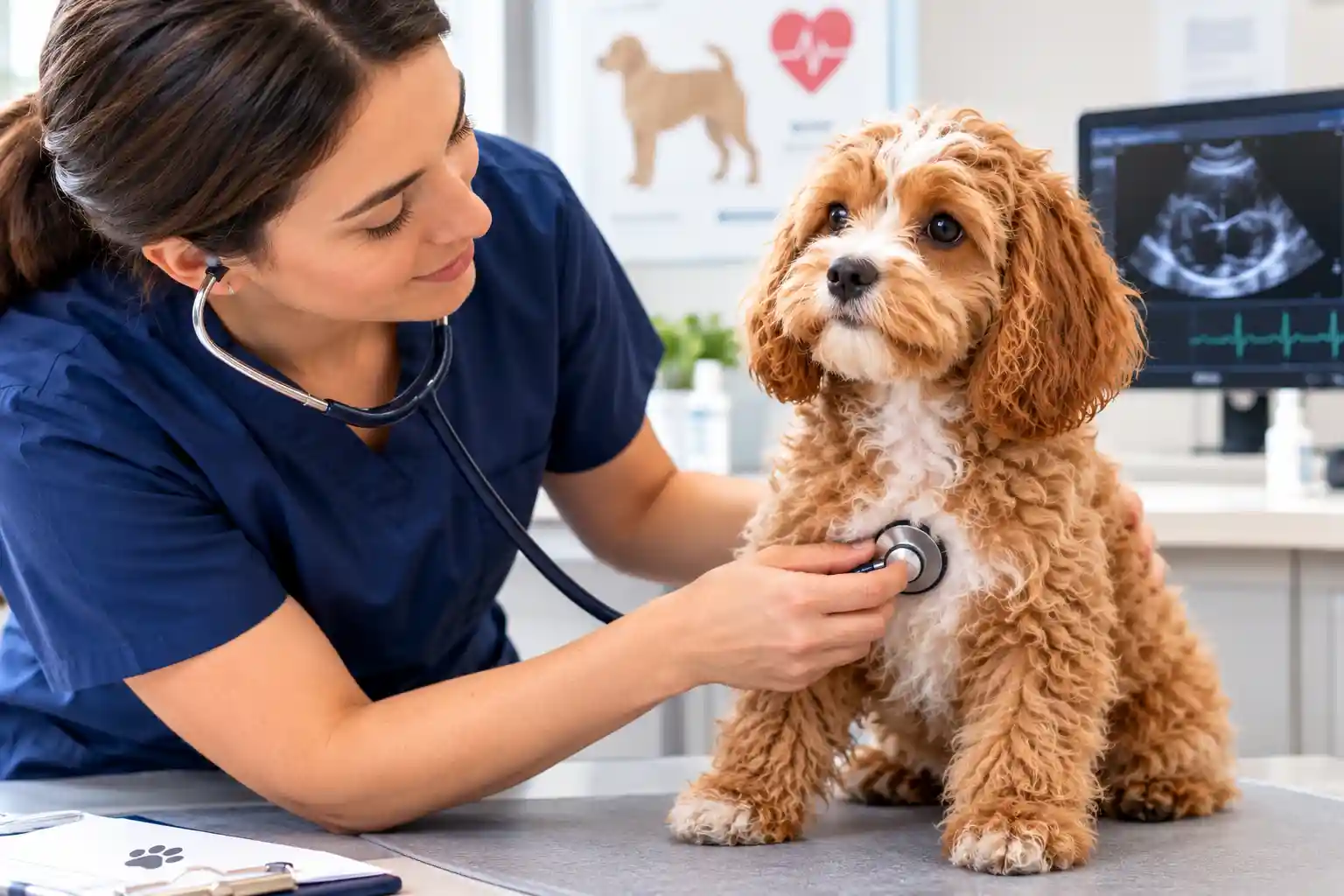
- Ask for the certificate date, the dog’s name or microchip number and the examiner
- Ask how old the parents were at their last exam, since murmurs often appear with age
- Treat “no murmur” in a young dog as encouraging, not as a guarantee
- Ask about heart disease in the parents’ relatives
Our Cavapoo lifespan guide explains the signs of heart disease and why it matters for longevity.
Eye Tests and Kneecap Checks
An eye exam by a veterinary ophthalmologist should be repeated yearly, because both Cavaliers and Poodles can develop hereditary cataracts and retinal disease. A kneecap certificate shows whether the patella sits properly, since slipping kneecaps are common in small dogs. Neither test is a legal requirement, so you have to ask.
| Test | Ask for | Good sign |
|---|---|---|
| Eye exam | Certificate from an ophthalmologist, dated within the past year | Clear result and repeat testing |
| Kneecap check | Certificate or vet report | Normal kneecaps in both parents |
MRI Screening for Syringomyelia
Syringomyelia is a painful spinal condition seen in Cavalier lines. It cannot be detected by a physical exam, so screening requires an MRI scan read by a specialist. Breed clubs recommend scanning breeding dogs once they are mature, and results are usually graded.
Many Cavapoo breeders do not scan, so an MRI result is a strong sign of care. If a breeder has scan results, ask who read them, how old the dog was and what the grade means. If they do not scan, ask what else they do to reduce the risk. Our Cavapoo lifespan guide lists the symptoms to watch for.
DNA Health Tests to Ask a Cavapoo Breeder About
DNA tests identify whether a dog carries the gene for an inherited condition. They are done once, usually with a cheek swab, and results last for life. For the Cavalier parent, accredited schemes list curly coat/dry eye and episodic falling as standard.
Some breeders and labs also test for degenerative myelopathy, macrothrombocytopenia and other conditions. For the Poodle parent, the Poodle Club of America lists a prcd-PRA DNA test, a yearly eye exam by a veterinary ophthalmologist and a kneecap evaluation for Toy and Miniature Poodles (Miniatures also need a hip evaluation), and the AKC list adds von Willebrand disease type I and PRA-rcd4 DNA tests.
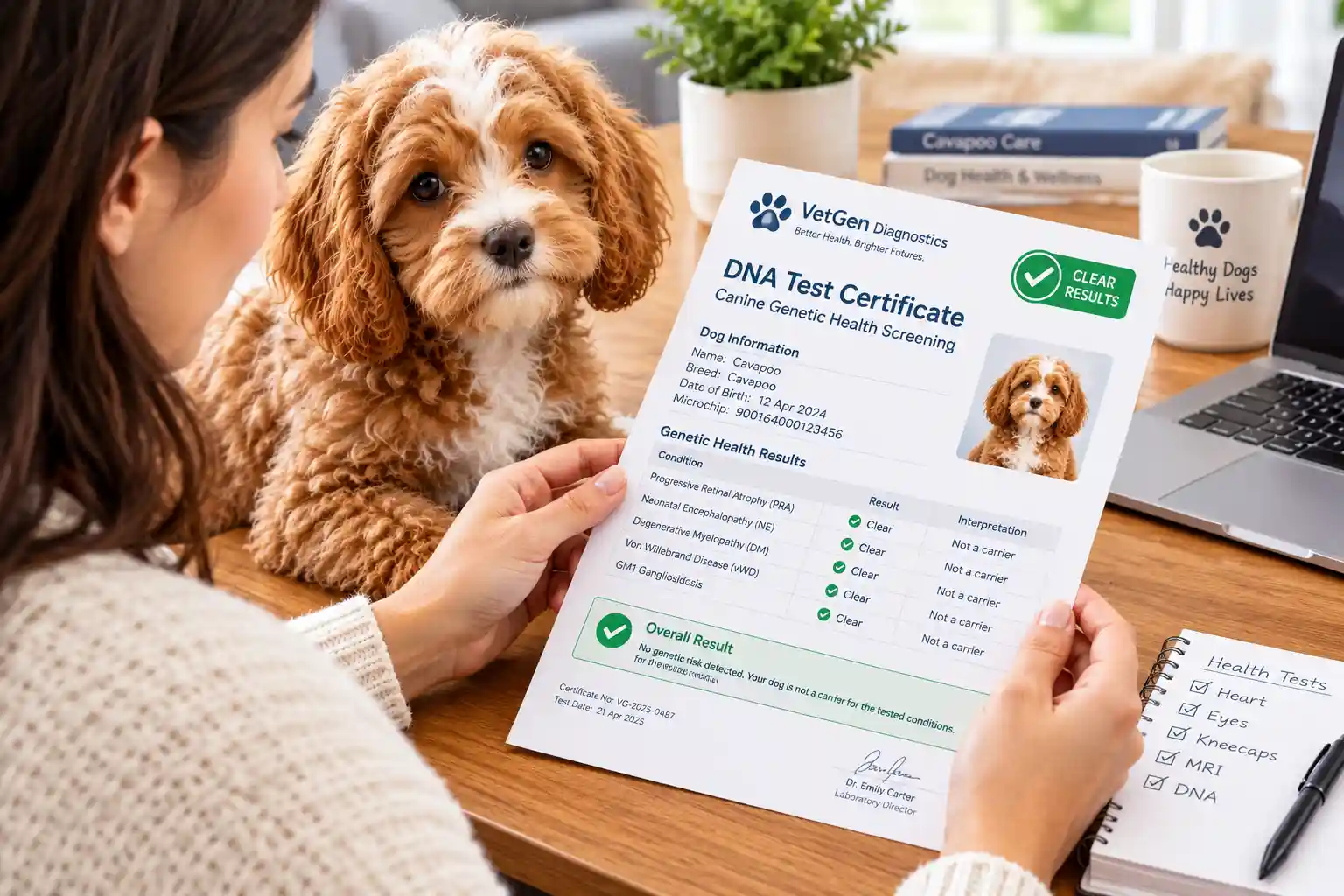
| Result | Meaning | Safe pairing |
|---|---|---|
| Clear | No copy of the faulty gene | With any result |
| Carrier | One copy, usually healthy, can pass it on | Only with a clear dog |
| Affected | Two copies, may develop the condition | Avoid breeding |
Pairing a carrier with a clear dog avoids affected puppies, but two carriers can produce affected pups, so a responsible breeder checks both parents. Some advisers say extra DNA tests become necessary when a breeder backcrosses to a parent breed or breeds two Cavapoos together, as with F1b or F2 litters. Our F1b Cavapoo guide explains the generations.
How to Verify Health Test Certificates
Seeing a stack of papers is not enough. Check each one before you trust it.
- The certificate names the dog or gives its microchip number
- The test date and examiner or lab are clearly shown
- It comes from a recognised body, specialist or lab, not just a breeder’s note
- The results match what the breeder told you
- The parents’ details match the dogs you meet
- You see the originals, not just photos or screenshots
A breeder who says the puppies are “vet checked” or “health guaranteed” is describing the puppies, not the parents. That is not health testing.
Parent Age and Breeding Practices
Cavalier breeding guidance advises that the mother should not be bred before about two and a half years of age, and many clubs recommend waiting longer for heart reasons. Ask for both parents’ birth dates, how many litters the mother has had and whether her tests are current. Frequent litters, very young mothers or several breeds on site are warning signs. Be wary of “teacup” or “tiny” puppy claims too, as explained in our Toy vs Mini Cavapoo guide.
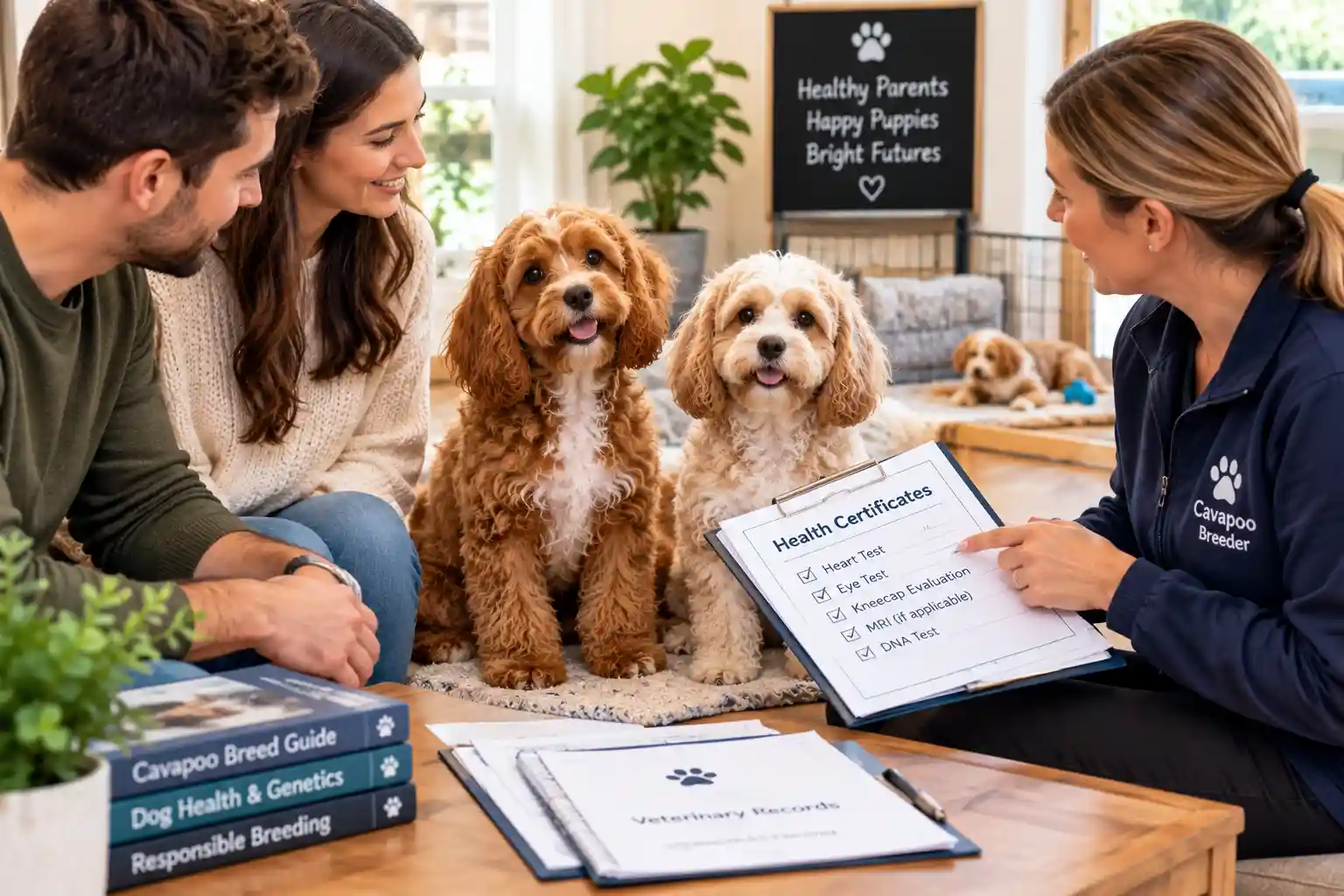
Questions to Ask: A Script for Your First Call
- Which health tests have both parents had, and may I see the original certificates?
- When were the heart and eye exams done, and by whom?
- What were the DNA results for each parent?
- Have the parents had an MRI for syringomyelia?
- How old are the parents, and how many litters has the mother had?
- Which generation is this litter, and what tests does that require?
- What does your contract say if a genetic condition appears?
- Will you take the puppy back at any age?
Notice how the breeder answers. A good breeder is open and detailed, and may offer extra information. Vague or defensive answers are a red flag.
What Health Tests Cannot Tell You
Tests lower risk, but they cannot remove it. Mitral valve disease and syringomyelia involve many genes and can still appear in puppies from tested parents. Testing does not cover every condition, and results only describe the dogs tested.
That is why a written contract, a health check by your own vet and pet insurance still matter.
After you bring your puppy home, book a vet visit and ask the vet to listen to the heart. Our Cavapoo puppy first week guide explains what to ask.
Do Health Tests Affect the Price?
Yes, usually. Heart exams, eye exams, MRI scans and DNA tests all cost money, and responsible breeders repeat some of them every year. That is one reason a well-tested litter costs more than an untested one. A very low price should make you ask what was skipped. Our Cavapoo price guide shows typical ranges and what the price should include.
Health Tests to Ask a Cavapoo Breeder: The Bottom Line
The health tests to ask a Cavapoo breeder for are a specialist heart exam, an eye exam and a kneecap check on both parents, DNA tests for known Cavalier and Poodle conditions, and ideally an MRI for syringomyelia.
Insist on original certificates that name the dog, check the dates and examiners, and treat vague answers as a reason to walk away.
Ready to compare breeders?
Health tests are one part of a good breeder. Learn the green and red flags before you visit.
Read the Breeder GuideFrequently Asked Questions About Cavapoo Health Tests
What health tests should a Cavapoo breeder do?
Both parents should have a heart exam, an eye exam and a kneecap check, plus DNA tests for inherited conditions in the Cavalier and Poodle lines. MRI screening for syringomyelia is optional but a strong sign of care.
Does a crossbreed need fewer health tests?
No. A Cavapoo inherits the risks of both parents, and crossing two breeds does not automatically remove them. Vets and breed clubs warn that crossbreeds can double up on health problems rather than avoid them.
Which DNA tests matter for the Cavalier parent?
Accredited-breeder schemes list curly coat/dry eye (CC/DE) and episodic falling (EF) as standard. Some breeders also test for conditions such as degenerative myelopathy and macrothrombocytopenia. Ask your vet which apply.
Which tests apply to the Poodle parent?
Commonly an eye exam, a kneecap check and DNA tests such as prcd-PRA and von Willebrand’s disease type I. The exact list depends on the Poodle type, so ask the breeder to name the tests.
What does clear, carrier and affected mean?
Clear means no copy of the faulty gene. A carrier has one copy and is usually healthy but can pass it on. Affected dogs have two copies. Pairing a carrier with a clear dog avoids affected puppies, and two carriers risks them.
How do I verify a health certificate?
Check that it names the dog or gives its microchip number, shows the test date and examiner, and comes from a recognised body or lab. A breeder’s word that puppies are “vet checked” is not health testing.
How old should the parents be?
Cavalier breeding guidance advises that the mother should not be bred before about two and a half years old, and heart and eye certificates should be recent. Ask for both parents’ ages.
Do health tests guarantee a healthy puppy?
No. They lower the risk of known inherited conditions, but complex conditions such as mitral valve disease and syringomyelia cannot be eliminated by a single test. Insurance and regular vet care still matter.
Why do breeders who test charge more?
Heart exams, eye exams, MRI and DNA tests cost money each year, and responsible breeders also spend on care and support. A price far below the typical range is a warning sign. See our Cavapoo price guide.
Sources and Further Reading
- Dogs New Zealand, Accredited breeder health tests: Cavalier King Charles Spaniel (mandatory and optional test list)
- Dogs Australia, What to look for when buying a Cavalier puppy (DNA tests, crossbreed concerns)
- Laboklin, Cavalier King Charles Spaniel genetic test combinations (CC/DE and EF test panels)
- Poodle Club of America, Health testing for Poodles (Toy and Miniature Poodle tests)
- American Kennel Club, Toy group health testing requirements (recommended Poodle DNA tests)
This guide is general information and not a substitute for advice from your vet. Test requirements vary by country and breed club, so confirm the current list with a qualified vet.
Written by Rachel DoyleFounder of The Cavapoo Guide and owner of Winnie and Ziggy. About Rachel →
Medically reviewed by Dr. Amanda Ferris, DVMLicensed veterinarian specializing in small companion breed health. About Dr. Ferris →
This article is part of our Complete Cavapoo Breed Guide →

4 Comments