F1b Cavapoo vs F1 vs F2: Differences & Which to Choose
Quick answer: In the F1b Cavapoo vs F1 vs F2 comparison, an F1 is a 50/50 Cavalier x Poodle cross, an F1b is an F1 bred back to a Poodle (about 75% Poodle, usually curlier and lower-shedding), and an F2 is two F1 Cavapoos bred together (about 50/50, with the most variation). Generation hints at coat and shedding, but it never guarantees them or affects health.
Breeders list “F1”, “F1b” and “F2” on every litter, yet buyers rarely know what the labels mean, which is why the F1b Cavapoo vs F1 vs F2 question comes up so often. This guide to F1b Cavapoo vs F1 vs F2 explains how each generation is bred, what to expect from the coat, size and temperament, which myths to ignore and how to choose the right generation for your home.
Why Cavapoo Generation Labels Exist
A Cavapoo is a crossbreed, not a standardised breed. Two Cavapoos from different breeders can look and behave quite differently, so breeders use generation codes to describe how a litter was produced. The “F” stands for “filial”, meaning offspring, and the number counts the generations since the original cross.
The label tells you the parents’ makeup, which gives a rough idea of the coat. It does not tell you the dog’s health, temperament or actual coat, and it never replaces meeting the parents.
F1b Cavapoo vs F1 vs F2 at a Glance: Every Generation Compared
| Generation | Parents | Approx. Cavalier / Poodle | Typical coat and shedding |
|---|---|---|---|
| F1 | Cavalier x Poodle | 50% / 50% | Wavy to curly, least predictable, light to moderate shedding |
| F1b | F1 Cavapoo x Poodle | 25% / 75% | Curlier, usually lower shedding |
| F1bb | F1b x Poodle | 12.5% / 87.5% | Very Poodle-like, often tight curls |
| F2 | F1 x F1 | 50% / 50% | Varied, hard to predict |
| F2b | F2 or F1 x F1b | About 37.5% / 62.5% | More consistent curl, lower shedding |
| F1b reverse | F1 x Cavalier | About 75% / 25% | Straighter, more Cavalier-like, sheds more |
| Multigen (F3+) | Cavapoo lines bred over generations | Varies | Can be consistent if carefully selected |
This F1b Cavapoo vs F1 vs F2 table shows averages only. Genes are shuffled at random, so an individual puppy can inherit more or less from either parent than the label suggests. The table is a guide to probabilities, not outcomes.
F1 Cavapoo: The Original Cross
An F1 Cavapoo has one purebred Cavalier King Charles Spaniel parent and one purebred Poodle parent. It is 50 percent of each, which is exactly why the coat is the least predictable of all the generations. One puppy may have a soft, wavy coat while a littermate has straighter, shedding-prone hair.
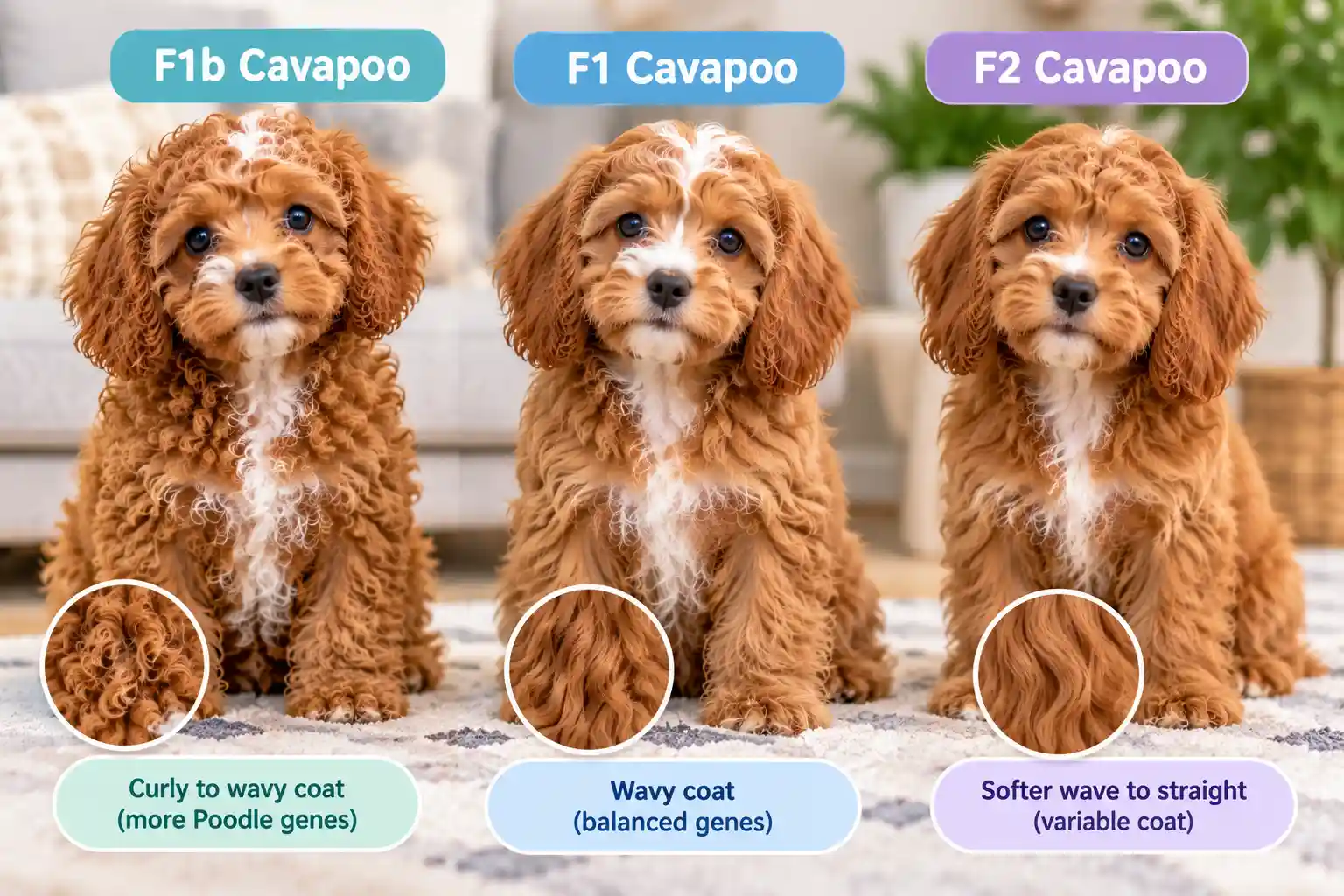
F1 dogs are generally low shedding, but the even genetic split means shedding varies more than with later generations. They often look more like the Cavalier, with rounder faces and softer waves. If you want the classic teddy-bear Cavapoo and can accept some variation, an F1 is a perfectly good choice.
F1b Cavapoo: Bred Back for a Curlier Coat
The “b” stands for backcross. An F1b Cavapoo is an F1 bred back to a purebred Poodle, so it is roughly 75 percent Poodle. More Poodle genes make a curly, low-shedding coat more likely, and many buyers with mild allergies specifically look for F1b dogs.
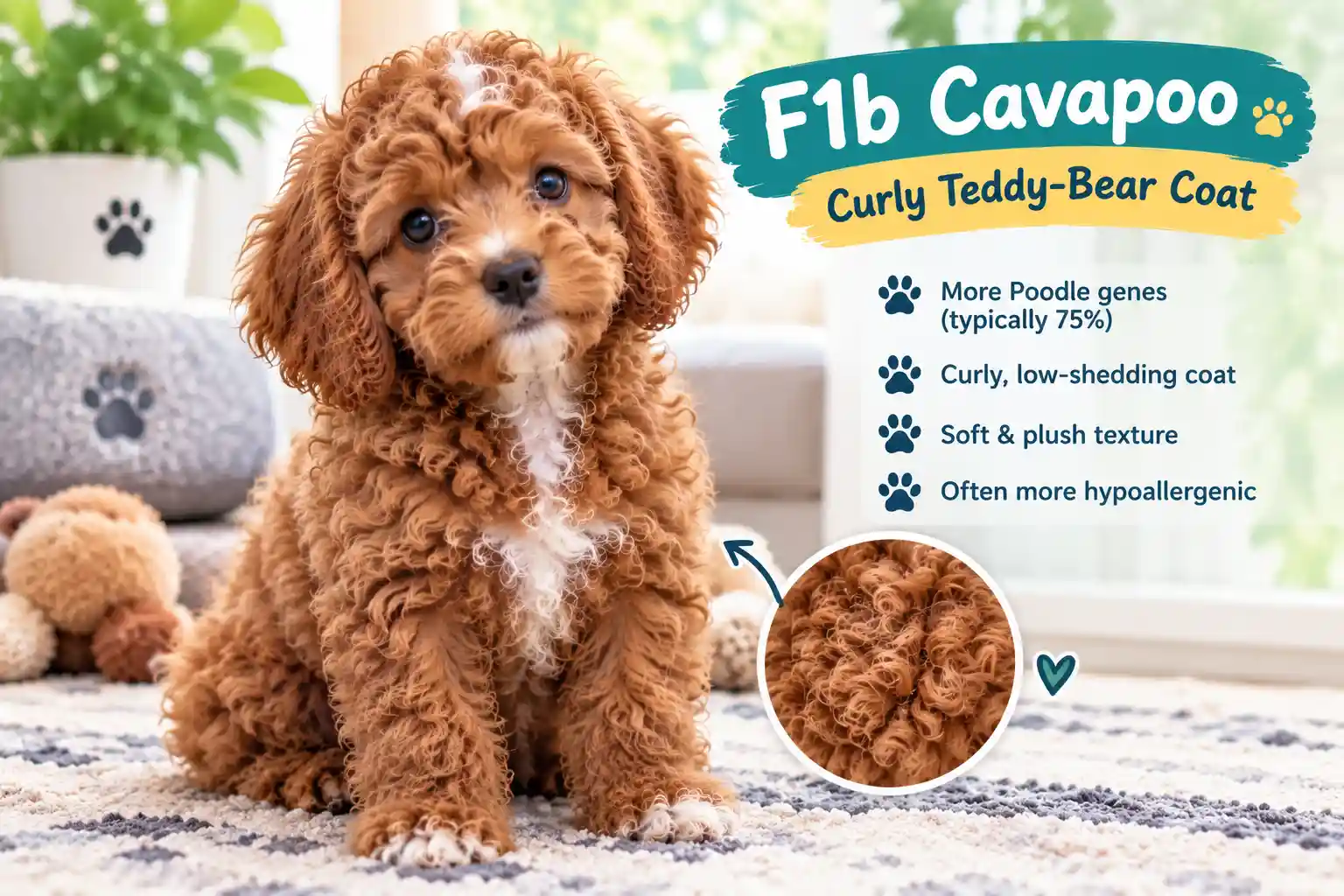
The trade-off is grooming. A curlier coat traps loose hair, but it also mats easily and usually needs more frequent brushing and professional trims. F1b dogs can also be slightly bouncier and more alert, reflecting more Poodle influence. Our Cavapoo temperament guide explains how the two parent breeds shape personality.
An F1bb is the next step: an F1b bred back to a Poodle again, around 87.5 percent Poodle. These dogs often have tight curls and look very Poodle-like, but they have lost more of the Cavalier’s softness and distinctive face, so they may not be what you imagined when you wanted a Cavapoo.
F2 and F2b Cavapoo: Cavapoo to Cavapoo
An F2 Cavapoo comes from breeding two F1 Cavapoos together. Because both parents are already half and half, the puppies can land anywhere on the spectrum: curly, wavy or straight. Breeders who produce F2 litters often have a good reason, such as a consistent line, but the coat is harder to promise.
An F2b is an F2 or F1 bred with an F1b to raise the Poodle percentage again. It is a way of tuning the coat while keeping some Cavalier influence. Multigen Cavapoos extend this process over several generations, and good breeders select for coat, size, temperament and health across each one.
F1b Cavapoo vs F1 vs F2: Coat, Shedding, Size and Temperament
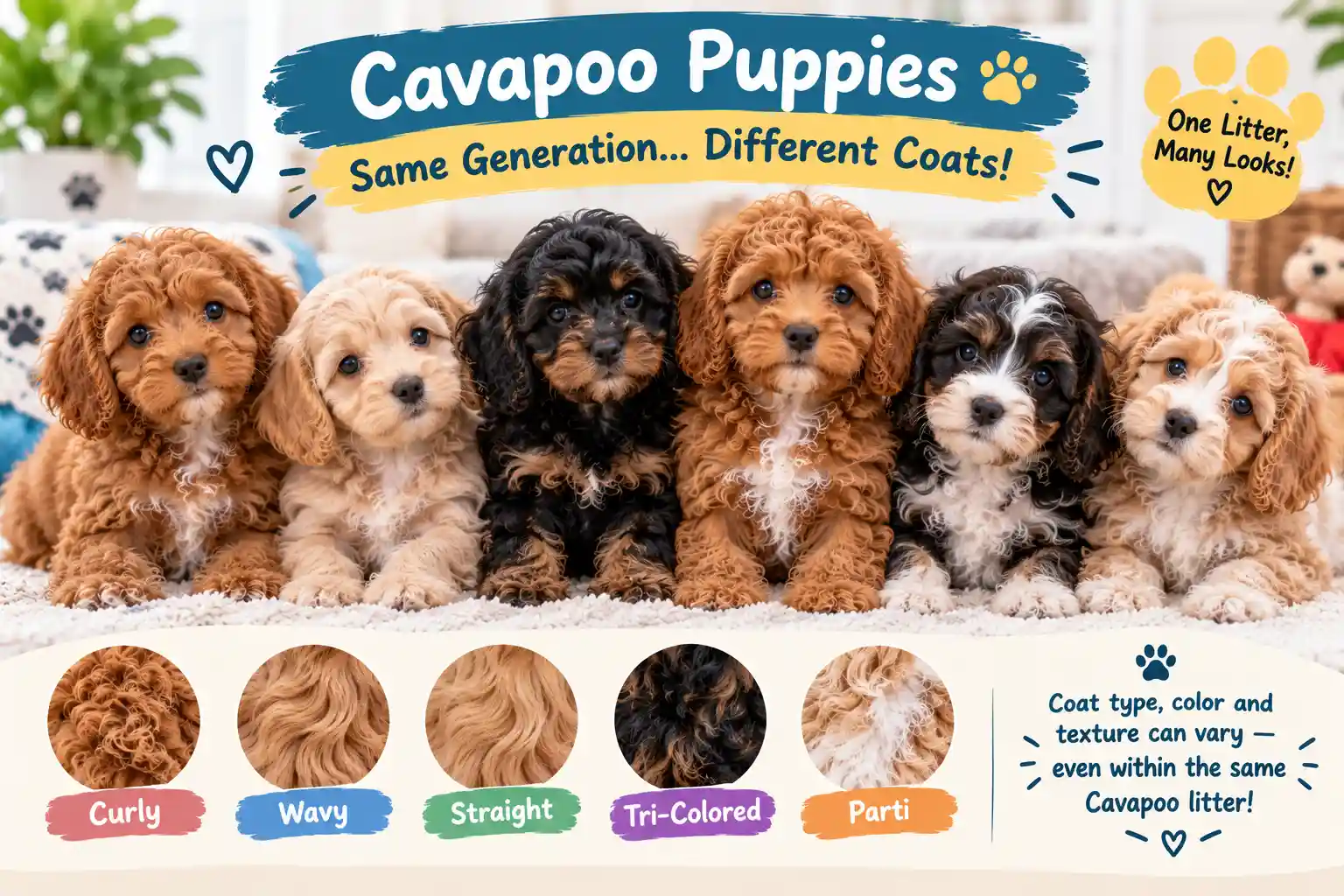
Generation affects coat more than anything else. Shedding and curl follow the Poodle percentage, but only as a probability. Size depends mainly on the size of the parents, not the generation, and temperament follows the individual parents and early socialisation.
| Trait | Does generation affect it? |
|---|---|
| Coat texture and curl | Yes, partly: more Poodle usually means curlier |
| Shedding level | Yes, partly: more Poodle usually means less |
| Grooming needs | Yes: curlier coats mat more and need more care |
| Adult size | Barely: depends on parents’ sizes |
| Temperament | Barely: depends on individual parents and upbringing |
| Health and lifespan | No reliable evidence: depends on parent health testing |
A lower-shedding coat reduces hair around the house but does not change allergen proteins in saliva and dander. Our guide on whether a Cavapoo is hypoallergenic explains the science, and our do Cavapoos shed guide covers coat types and puppy-coat timing. Colours are inherited independently of generation, which we cover in our Cavapoo colors guide.
F1b Cavapoo vs F1 vs F2: Generation Myths to Ignore
Three claims come up repeatedly in breeder marketing, and each is overstated.
- “F1 means healthier because of hybrid vigour.” No reliable study shows generation changes health or lifespan; parent health tests do
- “F1b means hypoallergenic.” F1b dogs often shed less, but allergies are triggered by dander and saliva, so no generation is allergy-proof
- “My F1b will definitely have a curly coat.” Coat is polygenic and can change when the puppy coat is replaced at around six months
Health, not generation, is what matters most. Good breeders health-test both parents, including heart, eyes, kneecaps and ideally MRI for syringomyelia. Our Cavapoo lifespan guide explains why these tests protect your dog’s future.
Which Cavapoo Generation Should You Choose?
| If you want… | Consider |
|---|---|
| The lowest likely shedding | F1b or F1bb |
| A classic soft, wavy teddy-bear look | F1 |
| A more Cavalier-like face and calmer feel | F1 or F1b reverse |
| A consistent coat from a proven line | F2b or multigen from a careful breeder |
| Lowest grooming effort | A wavy, not tight-curly, coat of any generation |
When weighing F1b Cavapoo vs F1 vs F2, there is no best generation, only the best fit. If allergies or shedding are your priority, lean toward more Poodle but test your reaction to the specific dog. If you want a relaxed, cuddly, Cavalier-like dog, you may prefer the F1 or even an F1b reverse. See the Cavapoo breed guide for the wider picture on size, care and temperament.
Questions to Ask a Breeder About Generation
- Which generation is this litter, and what are the parents’ breeds and generations?
- Can I meet both parents and see photos of adult dogs from earlier litters?
- What were the parents’ health-test results, including heart and eye certificates?
- How old were the parents when bred, and how many litters has the dam had?
- What coat and shedding should I expect, and do you guarantee anything in writing?
A breeder who answers confidently and shows evidence is a good sign. For a full set of warning signs and verification steps, read our guide to finding a reputable Cavapoo breeder.
F1b Cavapoo vs F1 vs F2: The Bottom Line
In the F1b Cavapoo vs F1 vs F2 decision, generation shapes the odds for coat and shedding but not for health, temperament or lifespan. F1b is the usual pick for lower shedding and a curly coat, F1 suits those who want the classic wavy look, and F2 or multigen dogs can work well when a careful breeder has selected for consistency.
Look past the label. Meet the parents, review health certificates and spend time with the puppy before you commit.
Want to understand shedding and allergies?
Generation is only part of the story. See what the science says about Cavapoos and allergies.
Read the Allergy GuideFrequently Asked Questions: F1b vs F1 vs F2 Cavapoos
What is the difference between F1, F1b and F2 Cavapoos?
An F1 is a Cavalier x Poodle cross (50% each). An F1b is an F1 bred back to a Poodle (about 75% Poodle). An F2 comes from two F1 Cavapoos (roughly 50% each, with more variation).
Is an F1b Cavapoo better than an F1?
Not better, just different. F1b dogs usually have curlier, lower-shedding coats and need more grooming. F1 dogs are more varied and often wavier. Health depends on the parents, not the label.
Which Cavapoo generation sheds the least?
F1b and F1bb generally shed least because they have more Poodle genes, but no generation is guaranteed. See our Cavapoo hypoallergenic guide.
What is an F1b reverse Cavapoo?
An F1 Cavapoo bred back to a Cavalier King Charles Spaniel instead of a Poodle, giving about 75% Cavalier. These tend to look and shed more like a Cavalier.
What does F2b mean?
An F2b is an F2 or F1 bred with an F1b or Poodle line to push the Poodle percentage up. Breeders use it to get a more predictable, curlier coat.
What is a multigen Cavapoo?
A Cavapoo with several generations of Cavapoo-to-Cavapoo breeding behind it. Coat and size can be more consistent, but only if the breeder selects carefully.
Do F1b Cavapoos cost more?
Often, yes, because buyers prefer the curlier coat. Price depends more on the breeder, health testing and region. See our Cavapoo price guide.
Does generation affect lifespan or health?
No reliable evidence says so. Parent health testing matters far more. See our Cavapoo lifespan guide and breeder checklist.
Can a breeder guarantee an F1b puppy will have a curly coat?
No. Coat type is influenced by several genes and can change as the puppy coat is replaced at around six months. Ask to see adult dogs from the same line.
Sources and Further Reading
- OodleLife, Cavapoo generations: F1, F1b and F2 (definitions, backcross)
- Petful, Do Cavapoos shed? (coat types and generation)
- Doodle Doods, Do Cavapoos shed? (generation and Poodle percentage table)
This guide is general information and not a substitute for advice from a vet or experienced breeder. Percentages are averages and individual puppies vary.
Written by Rachel DoyleFounder of The Cavapoo Guide and owner of Winnie and Ziggy. About Rachel →
This article is part of our Complete Cavapoo Breed Guide →
9 Comments