Cavapoo Crate Training: Step-by-Step Guide & Schedule


Quick answer: Cavapoo crate training works best when it is gradual, positive and never used as punishment. Choose a crate big enough to stand, turn around, lie down and stretch, start with the door open and treats, feed meals inside, then build up time in small steps. A puppy under 6 months should not be crated more than three or four hours at a time, and no dog should be crated all day.
Cavapoo crate training can make toilet training, naps, nights and short absences much easier, but only when it is done kindly and slowly. This guide to Cavapoo crate training explains how to choose the right crate, a six-step plan based on RSPCA guidance, how long a puppy can safely stay inside, night routines, a sample daily schedule and how to fix whining. It also covers the mistakes that turn a safe den into a source of stress, and when crate problems point to separation anxiety.
Disclosure: some links in this guide are Amazon affiliate links. If you buy through them we may earn a small commission at no extra cost to you.
What Is Cavapoo Crate Training, and Do You Need It?
Cavapoo crate training means teaching your puppy that a crate or playpen is a safe, comfortable den where good things happen. The RSPCA describes a crate as a safe, secure area a dog can go into for short periods, and lists its uses as an open den, a training aid for toilet training and learning to be left alone, short-term confinement when you cannot supervise, vet-advised recovery and travel. It is a useful tool, not a requirement, and it works only when your puppy likes it.
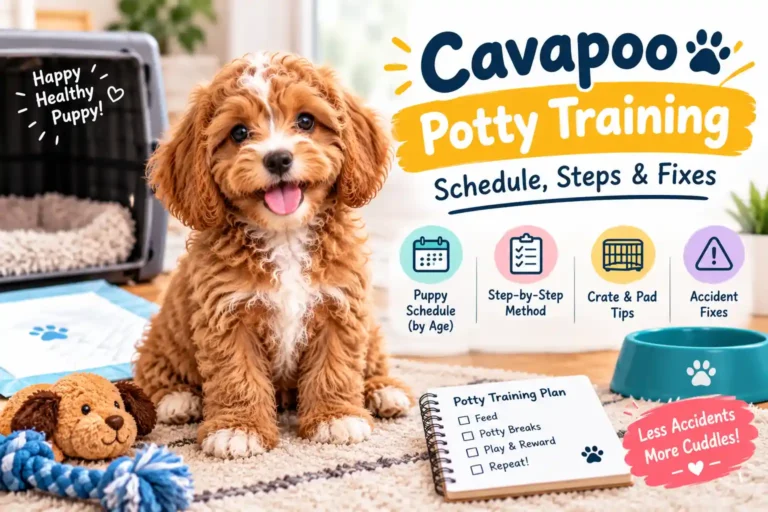
Many people connect crates with toilet training, because puppies usually avoid soiling where they sleep, and our Cavapoo potty training guide shows how the two fit together. Crates also help when you cannot watch your puppy, which matters during the busy early weeks covered in our puppy first week guide.

Cavapoo Crate Training: Choosing the Right Crate and Setting It Up
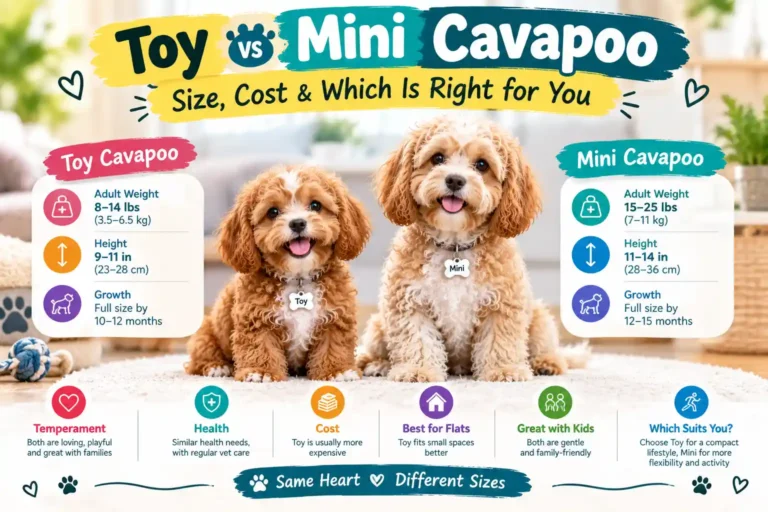
For Cavapoo crate training, the right crate is big enough for your dog to stand, turn around, lie down and stretch out, according to the RSPCA. For a puppy, buy one they can grow into, and ideally one with a divider panel so you can adjust the space. A crate that is too large invites a puppy to toilet at one end, and one that is too small is uncomfortable. Cavapoos vary from about 8 to 25 pounds as adults, so check your puppy’s likely size in our Cavapoo growth chart and our toy vs mini Cavapoo guide.
| Crate detail | Guidance |
|---|---|
| Size | Stand, turn around, lie down and stretch (RSPCA); one UK breeder suggests 24 inches for Toy-size and 30 inches for Miniature-size doodles, so check each brand’s size chart |
| Type | Wire crate with a divider, or a playpen |
| Example | MidWest iCrate 24-inch double door (model 1524DD), which includes a divider panel. MidWest lists the 24-inch size for dogs of about 11 to 25 lb, so check that range against your puppy’s likely adult weight |
| Bedding | Comfortable, soft bedding |
| Location | Where the family spends time, not in direct sunlight or a draught (RSPCA) |
| Contents | Safe chew toys; a clip-on water bowl that cannot tip over |
| Cover | Covering part of the crate can help nervous dogs (RSPCA) |
Do not travel with your puppy in an adult-sized crate: the RSPCA says they are better protected in a smaller space. Our puppy checklist lists the other supplies to buy before pickup.
How to Crate Train a Cavapoo: The 6-Step Plan
This Cavapoo crate training plan follows the RSPCA’s step-by-step guidance. The rule throughout is to think positive and go slowly, because the crate should always be linked with something pleasant.
- Introduce the crate with the door open. Fix the door open so it cannot swing shut and frighten your puppy. Place treats or a chew inside, let your puppy explore, then throw treats progressively closer and inside. Keep sessions short, about three minutes, and expect this step to take minutes or days.
- Feed meals in the crate. Put the bowl at the back. If your puppy eats happily, close the door, and open it as soon as they finish. Over several meals, leave the door closed a few minutes longer, up to about ten minutes after eating. If your puppy is reluctant, move the bowl back toward the door.
- Practise short periods with you nearby. Close the door and stay quietly beside the crate while your puppy enjoys a KONG or chew. After about five minutes, leave the room calmly, return, sit for a moment, then let your puppy out.
- Build the time out of sight. Repeat several times a day, gradually lengthening the time you are out of sight, up to about half an hour, at different times of day.
- Add short absences. Only when your puppy can settle for half an hour without distress, exercise them first, give a small meal, offer a toilet trip, and keep leaving and returning low-key.
- Let them out at the right moment. The RSPCA warns that letting a puppy out when it is being vocal teaches them to make noise to get attention. Wait for even a small gap in the noise, then open the door.
If your puppy whines to get out or shows panting, excessive barking, cowering or aggression, the RSPCA says you may have increased the time too quickly: go back a few steps and allow your puppy to eat in the crate with the door open again.
How Long Can a Cavapoo Puppy Stay in a Crate?
In Cavapoo crate training, a puppy under 6 months should not stay in a crate for more than three or four hours at a time, according to Humane World for Animals, because they cannot control their bladders or bowels for longer. The RSPCA says adult dogs who are well trained and happy in their crate are normally comfortable for about three hours, and that it is never acceptable to shut a dog in a crate all day while you go to work.
| Dog | Maximum in a crate at one time | Notes |
|---|---|---|
| Puppy under 6 months | About 3 to 4 hours at most (Humane World for Animals) | Often much less in the early weeks; plan toilet trips |
| Trained adult | About 3 hours is comfortable (RSPCA); 4 to 5 hours at most in the day (Humane World) | With exercise, toilet and play before and after |
| Any dog | Never all day | Prolonged crating can lead to anxiety and discomfort |
You will see a popular ‘age in months plus one hour’ rule on many breeder sites. We found no authoritative source for it, so treat it as a rough guess and follow the limits above, using fewer hours when your puppy is young or anxious. Because PetMD names separation anxiety as the biggest consideration with the breed, shorter and gradual is safer. See our separation anxiety guide and Is a Cavapoo a good first dog? for planning work and care.
Cavapoo Crate Training at Night
For Cavapoo crate training at night, keep the crate in your bedroom for the first few nights so your puppy can hear and smell you, then move it gradually if you wish. Humane World for Animals notes that puppies often need to go outside during the night, and you will want to hear them when they whine to be let out. That makes night training a toilet question as well as a settling question.
- Wind down: reduce noise and activity before bed, and give a final toilet trip.
- Settle calmly: offer a safe chew, say a quiet goodnight and leave the light low.
- Night whining: work out whether your puppy needs the toilet. If yes, go out quietly, no play, then back to the crate. If no, wait for a gap in the noise before opening the door.
- Do not give in to attention whining: Humane World warns this teaches a puppy to whine loud and long to get what they want.
- Alternative: if your puppy needs to be near you, a tether in the bedroom is another option.
Our potty training guide has a full toilet routine, and if the whining turns into barking, see our Cavapoo barking guide.
A Sample Daily Cavapoo Crate Training Schedule (10 to 12 Weeks)
| Time | Activity | Crate use |
|---|---|---|
| Wake up | Straight outside to the toilet, then breakfast | Eat in or near the crate |
| Morning | Short play and training, then toilet trip | Nap in the crate, about 1 to 2 hours |
| Midday | Meal, toilet, play and a puzzle toy | Nap in the crate |
| Afternoon | Gentle exercise, socialising and training | Crate time with a stuffed chew |
| Evening | Meal, play and toilet trip, then calm time | Short crate settle |
| Bedtime | Final toilet trip, calm wind-down | Overnight in the crate by your bed |
This Cavapoo crate training schedule is a sample, not a rule. Use the time limits above, take your puppy outside straight after waking, and adjust to your puppy. For exercise suited to age, see our Cavapoo exercise guide, and for meals see our feeding guide.

Fixing Whining, Barking and Refusing to Enter
| Problem | Likely cause | What to try |
|---|---|---|
| Whines as soon as the door closes | Progressed too fast | Go back a step; shorten sessions; reward calm (RSPCA) |
| Whines at night | Needs the toilet or wants company | Quiet toilet trip if needed; crate by the bed; do not reward noise |
| Barks in the crate | Boredom, excitement or frustration | More exercise first, a stuffed chew; see our barking guide |
| Will not go in | Crate not yet linked with good things | Door open, treats, meals; never force |
| Chews bedding | Teething or boredom | Safe chews; check bedding; see our puppy biting guide |
| Panics, pants or cowers | Possible separation anxiety | Stop and seek help, as below |
Most Cavapoo crate training problems come down to speed or unmet needs. For chewing and teething, see our Cavapoo puppy biting guide.
Crate Training Mistakes to Avoid
These mistakes undermine Cavapoo crate training and can turn a safe den into a source of stress.
- Using the crate as punishment or a time-out. The RSPCA says it must never be a ‘sin bin’ or used to stop unwanted behaviour.
- Crating for too long. Follow the time limits and never crate all day.
- Going too fast. Move to the next step only when your puppy is relaxed.
- Letting your puppy out when it is noisy. Wait for a small gap, as the RSPCA advises.
- Making a big fuss when leaving or returning. The RSPCA says keep leavings and arrivals low-key.
- Isolating the crate too early. Place it where the family spends time, at least at first.
Crate vs Playpen: Which Is Better for a Cavapoo?
In Cavapoo crate training, neither is better for every dog. The RSPCA treats a crate and a puppy playpen as similar tools, designed as a safe, secure area. A crate suits a den and sleep, while a playpen gives more room for bed, water and a toilet area when you are out of the room. Many owners use both: a playpen in the living area and a crate by the bed. Choose what your puppy accepts, and keep either associated with good things.
If you choose a playpen, pick a height your puppy cannot climb or jump out of. For a growing Cavapoo we would lean toward a 30-inch pen, such as the MidWest 30-inch exercise pen (model 552-30), rather than a 24-inch one. It has eight 24-inch-wide panels that make about 16 square feet and it folds flat for storage. Reviewers note that a pen can slide on smooth floors, so set it up on a rug or in an octagon shape for stability, and never leave a puppy unsupervised in a pen that could tip or be climbed.
When Cavapoo Crate Training Is Not Working: Separation Anxiety
Some puppies panic during Cavapoo crate training because they are confined or alone, and a crate does not fix that. The RSPCA lists panting, excessive barking, cowering or aggression as signs you have gone too fast, and if they continue, your puppy may be anxious rather than stubborn. PetMD notes that Cavapoos bond closely and that separation anxiety is the biggest consideration with the breed. Stop pushing, go back to the start, and see our separation anxiety guide. If you are worried about your puppy’s behaviour, the RSPCA advises contacting your vet, who can refer you to a clinical animal behaviourist.
Can You Crate Train an Older or Rescue Cavapoo?
Yes, Cavapoo crate training works for adults too, but go more slowly. The RSPCA’s steps apply to any dog or puppy, and an adult that links the crate with good things will usually settle. Adults can hold their bladders longer than puppies, but the same limits apply: no all-day confinement, and about three hours is comfortable for a trained adult.
If a rescue dog has had bad experiences with confinement, use a playpen or an open den first, and ask a behaviourist for help. See our Cavapoo breed guide for general care.
Cavapoo Crate Training: The Bottom Line
Cavapoo crate training works when the crate is a comfortable den, introduced slowly with treats and meals, never used as punishment and never used all day. Choose a crate big enough to stand, turn, lie and stretch, keep puppy stretches to three or four hours at most, plan night toilet trips, and wait for a gap in the noise before opening the door. If your puppy panics, stop and get help.
Pair the crate with a toilet routine
Crate time and toilet training work best together. See a full routine for your Cavapoo puppy.
Read the Potty Training GuideFrequently Asked Questions About Cavapoo Crate Training
How do I crate train a Cavapoo puppy?
Start with the door open and treats inside, feed meals in the crate, build up a few minutes at a time, then practise short periods out of sight. The RSPCA says think positive and go in small steps.
How long does Cavapoo crate training take?
Cavapoo crate training takes from a few days to several weeks, depending on your consistency and your puppy. Short, frequent sessions work better than long, forced ones.
What size crate should a Cavapoo have?
One big enough to stand, turn around, lie down and stretch out. For a puppy, choose one they can grow into with a divider. Check your brand’s size chart and your puppy’s expected adult size.
How long can a Cavapoo puppy stay in a crate?
Under 6 months, no more than three or four hours at a time, according to Humane World for Animals, and often less when young. Trained adults are normally comfortable for about three hours.
Should I crate my Cavapoo at night?
Many owners do, with the crate by the bed at first. Puppies often need a toilet trip during the night, so plan for it and keep it calm.
What should I do if my Cavapoo cries in the crate?
Check whether your puppy needs the toilet. If not, wait for a gap in the noise before opening the door, because letting them out while vocal teaches them to cry for attention. If it is distress, go back a step.
Is crate training cruel?
Cavapoo crate training is not cruel when done properly. The RSPCA says crates can be a safe den if introduced positively, never used as punishment and never used all day. Misuse is what causes harm.
Can I leave my Cavapoo in a crate while I work?
Not for a full working day. The RSPCA says it is never acceptable to shut a dog in a crate all day while you go to work. Arrange a walker, daycare or someone at home.
Is a playpen better than a crate for a Cavapoo?
Neither is better for every dog. A crate suits sleep and a den, and a playpen gives more room when you are out of the room. Many owners use both.
What if my Cavapoo panics in the crate?
Stop and go back to the start. Panting, excessive barking, cowering or aggression are signs of distress, and persistent panic can mean separation anxiety. Speak to your vet or a behaviourist.
Affiliate disclosure: as an Amazon Associate we earn from qualifying purchases at no extra cost to you. We only link products we would recommend to a friend with a Cavapoo.
Sources and Further Reading
- RSPCA, Playpen and crate training a puppy, rspca.org.uk (uses, size, never punishment, step-by-step method, adult time limits)
- Humane World for Animals, Crate training 101, humaneworld.org (time limits by age, night toileting, training time)
- Patch, Puppy Crate Training: Tips & Tricks (reprinted guidance), patch.com (night toilet trips and not giving in to whining)
- PetMD, Cavapoo Dog Breed Health and Care, petmd.com (separation anxiety as the biggest consideration)
- Posh Poos, Cavapoochon Breed Guide, posh-poos.co.uk (example crate sizes for Toy and Miniature sizes)
- Choice Paws, Cavapoo Crate Training, choicepaws.com (breeder guidance on short routines and night settling)
- Jones Farm Puppies, How to Crate Train Your Cavapoo, jonesfarmpuppies.com (breeder guidance on crate size and building up time)
This guide is general information and not a substitute for advice from your vet or a qualified trainer. Cost figures are planning estimates and vary by region.

Written by Rachel DoyleFounder of The Cavapoo Guide and owner of Winnie and Ziggy. About Rachel →
This article is part of our Complete Cavapoo Breed Guide →